Official baseline
Pixmove lists Grave Robber as an instant game with 95% RTP, low volatility, a x5,000 max win and a July 10, 2026 release date.
An independent review of Pixmove's instant-win dig game. Every shovel strike either grows your multiplier or uncovers a skull — and the only real decision is when to stop. Below: the paytables for all three difficulties, measured from live play, plus the maths behind the cash-out.
We refreshed the homepage against Pixmove's current game record and the live demo flow, then moved the useful notes here near the start instead of leaving a generic update below the page.
Pixmove lists Grave Robber as an instant game with 95% RTP, low volatility, a x5,000 max win and a July 10, 2026 release date.
The accumulated multiplier is only paid after TAKE. A skull can erase the running total unless the dice save lands its single heart face.
EASY, MEDIUM and HARD are not labels. They change the ladder pace, the practical route to x5,000 and the kind of session a player is accepting.
The coffin stage is a double-or-nothing decision, so it should be treated as a separate risk choice rather than part of a guaranteed round value.
Use the browser version or operator lobby. We still found no official APK, so installable Grave Robber packages should be avoided.
Grave Robber is not a slot. There are no reels, no paylines and no free spins. It is an instant-win cash-out ladder: you place one bet, then dig repeatedly. Each dig either turns up a piece of treasure — whose value is added to a running multiplier — or a skull, which ends the round.
Your bet is deducted once, at the start of the round, not on every dig. From that moment the TAKE button is live, and the entire game is the tension between taking a modest certain win now and pushing one more shovel-stroke for a bigger one.
The one rule that matters: the multiplier only ever pays out if you press TAKE. A skull with no dice save wipes the whole accumulated amount, however large it had grown.
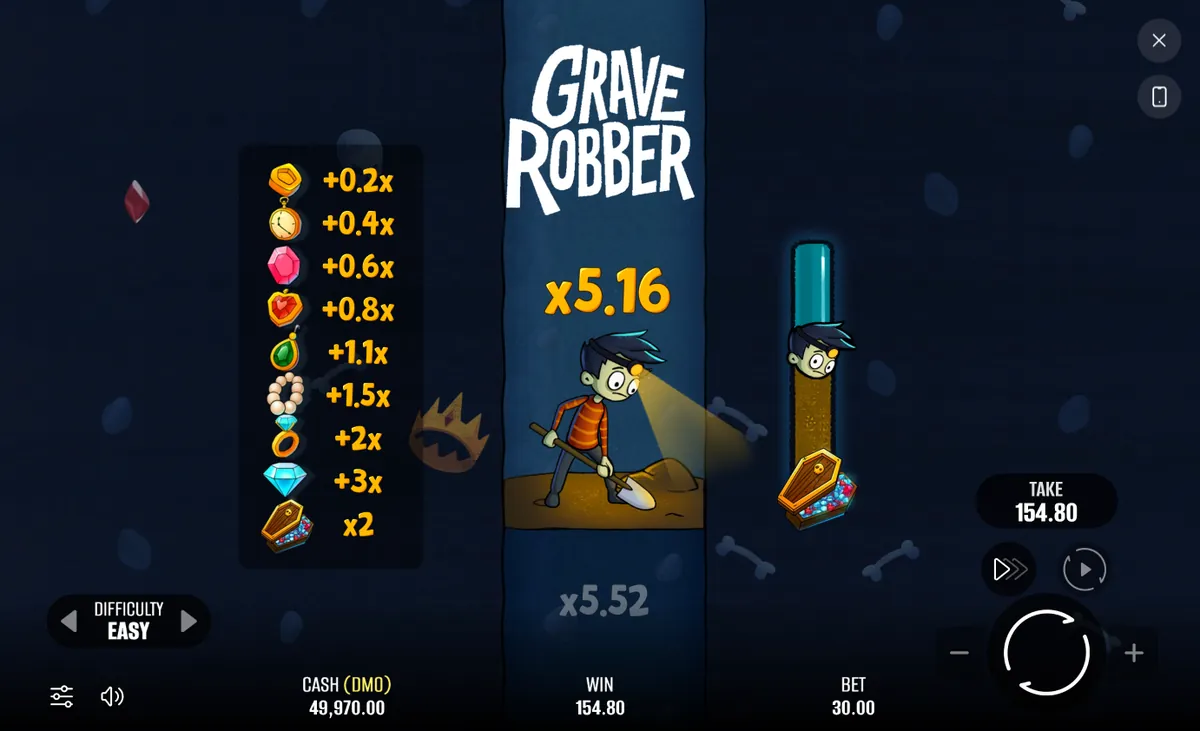
Before each round you pick EASY, MEDIUM or HARD. This is not a cosmetic setting. It swaps the entire paytable and the rate at which the multiplier climbs, which in turn changes how often a skull appears.
| Difficulty | Opening | Growth per dig | Top symbol |
|---|---|---|---|
| Easy | x1.04 | ≈ +7% | +3x |
| Medium | x1.13 | ≈ +13% | +20x |
| Hard | x1.32 | ≈ +37% | +125x |
There is a neat pattern buried in that table: the opening multiplier is always 1 + the growth rate. EASY opens at x1.04 and climbs 7% a dig; HARD opens at x1.32 and climbs about 37%.
The practical consequence is the headline number. Reaching the advertised x5,000 cap takes roughly 26 successful digs on HARD — but around 125 on EASY, which the round structure never allows. The x5,000 max win is effectively a HARD-mode-only outcome. The full breakdown, including every symbol value, is on the RTP and paytable page.
Instead of treasure, the shovel turns up a snake-wrapped skull. By default the round is over and the accumulated multiplier is lost.
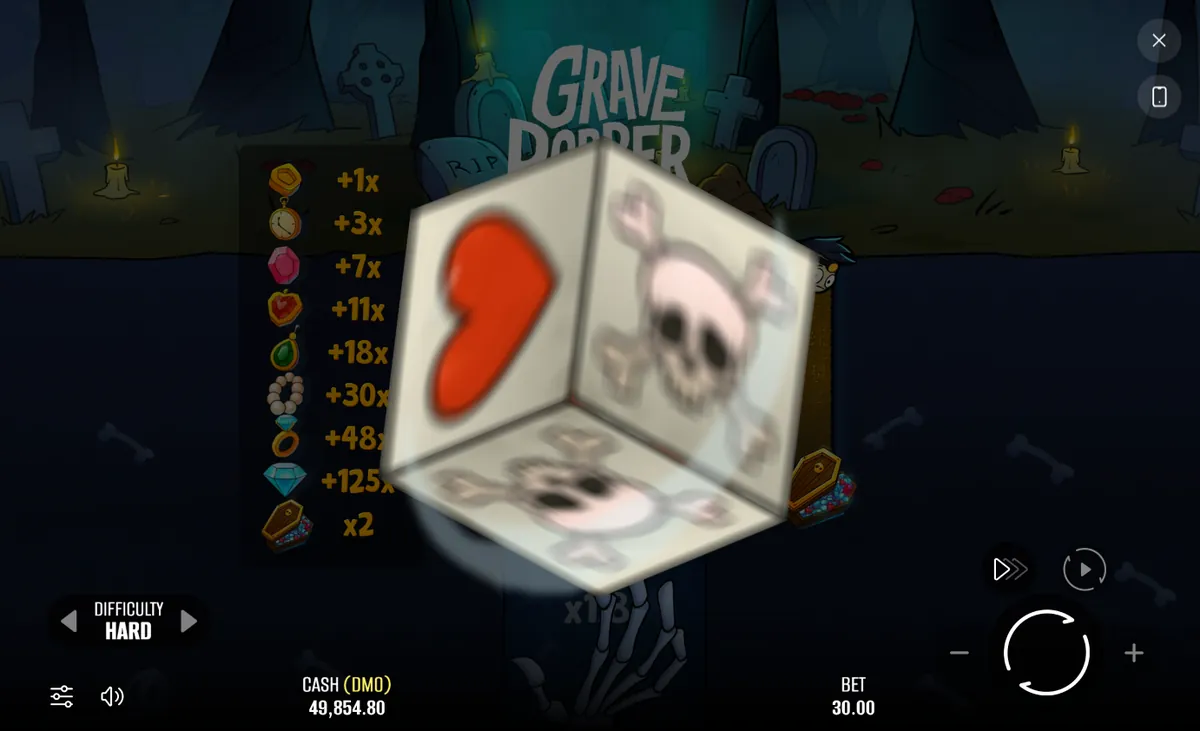
A six-sided die is rolled by a skeleton hand. Its faces carry skulls and a single red heart. Land the heart and you survive, keeping the multiplier you had already banked.
Survive all the way down to the crypt and a jewel-filled coffin doubles the accumulated multiplier — a flat x2 on every difficulty.
There is one further decision at the end: ONE LAST GAMBLE, a straight 50/50 to double the final win or lose it entirely. Each of these is covered in detail on the game features page.
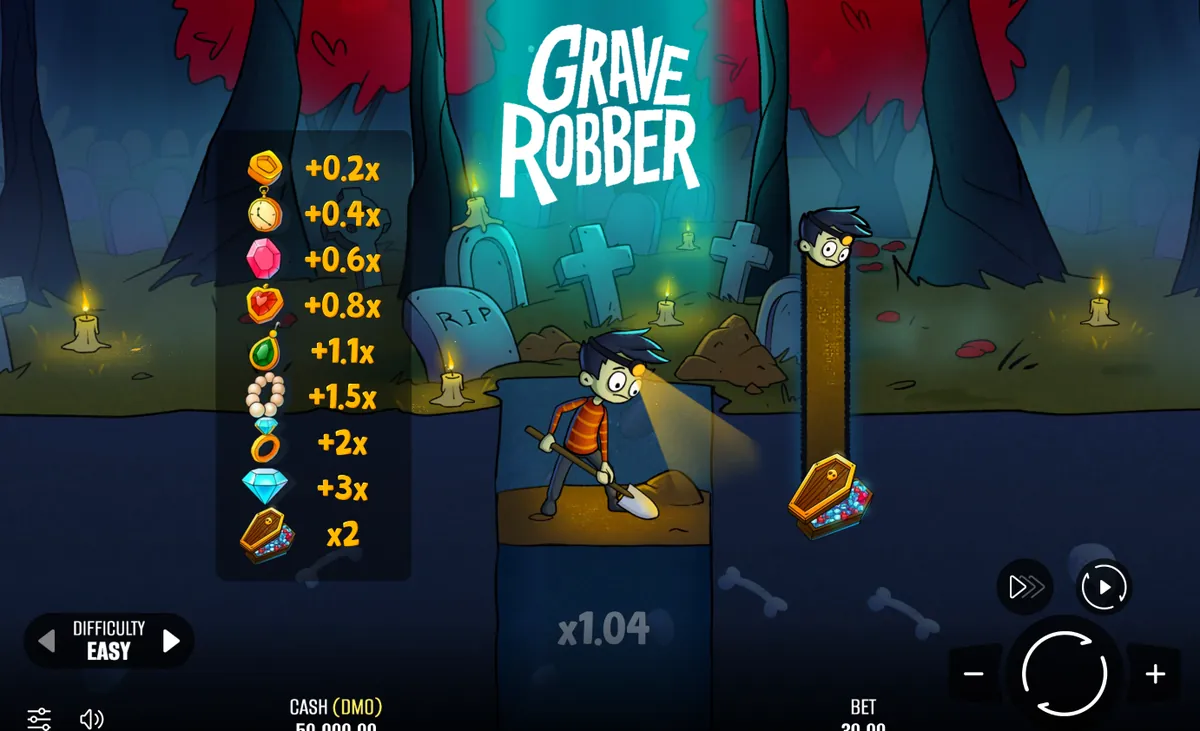
Reading the rules gives you the mechanics but not the feel, so here is a real round recorded at a 30.00 stake on EASY. The stake leaves the balance once, and the multiplier opens at x1.04 — meaning that even a single successful dig has already nudged you into profit, by four per cent.
From there each dig adds a treasure value and the multiplier compounds by roughly seven per cent. By the nineteenth dig it read x5.16, with the next step previewed underneath at x5.52, and the TAKE button offering 154.80 against the original 30.00. Pressing TAKE at that point returned the balance to 50,124.80 — a net gain of 124.80.
What that sequence hides is how quiet it is. Nineteen consecutive successful digs on EASY is unremarkable; the setting is built to let you accumulate slowly. The same run on HARD would have been a different experience entirely: at roughly 37% a dig, nineteen successes would have carried the multiplier past x400. The reason nobody sees that number often is that HARD ends the round far sooner, far more often.
Because the stake is taken once and never again, a round costs the same whether you dig twice or thirty times. The cost is fixed; only the risk to your accumulated multiplier grows. That asymmetry is what the whole game is built around.
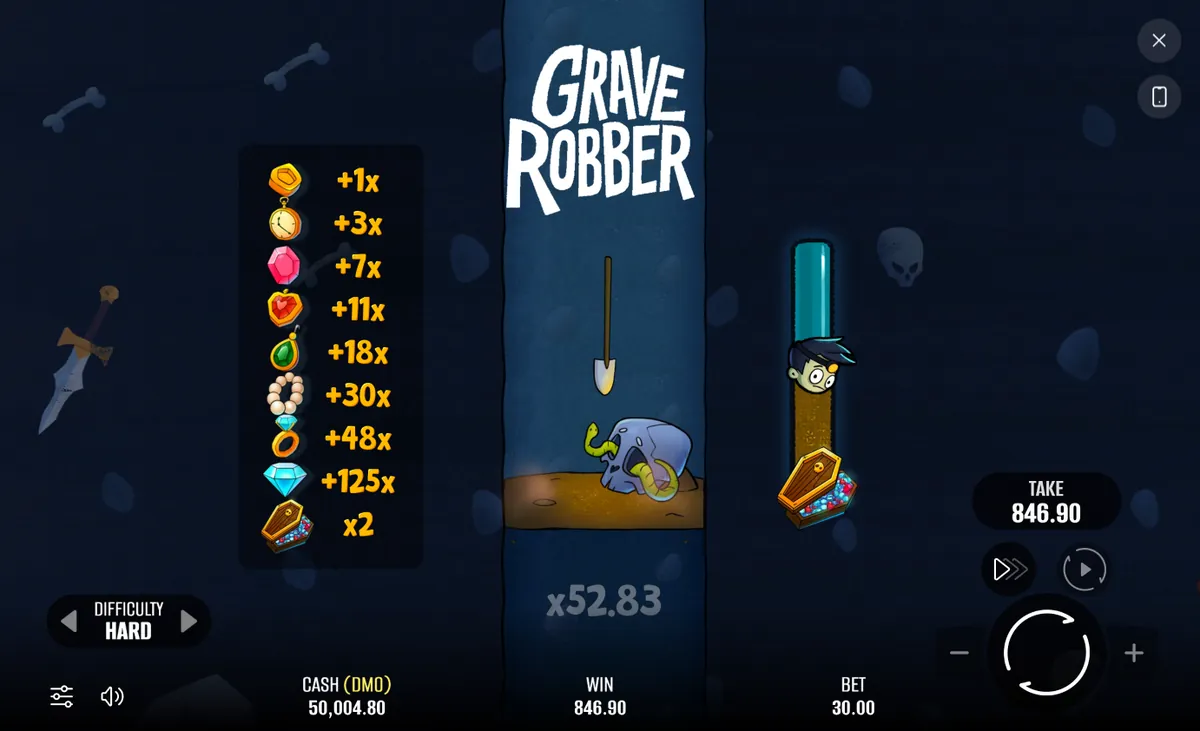
The skull, when it arrives, gives no warning. There is no tell in the animation and no build-up in the interface — the shovel simply turns up a snake-wrapped skull instead of a gemstone, and the multiplier that had been climbing for nineteen digs is gone. On one recorded HARD round the accumulated total stood at 846.90 when the skull appeared, the dice roll missed, and the round closed at zero. Nothing about the preceding digs made that outcome more or less likely.
Pixmove publishes a return to player of 95%. That figure describes an average across an enormous number of rounds: for every 100 units staked over that long run, the game is modelled to return about 95. The remaining 5% is the house edge, and it does not switch off.
What RTP does not do is predict your session. It is not a promise that a hundred rounds will return 95% of your stake, and it does not shift because of which difficulty you pick. All three settings sit under the same published figure. What changes between them is the shape of the return — EASY pays back often in small amounts, HARD pays back rarely in large ones, and the long-run average is engineered to land in the same place either way.
This is why the vendor's "Low" volatility label deserves care. It is a fair description of EASY. HARD, with a break-even survival requirement around 73% and a +125x diamond, behaves like a high-volatility game wearing the same badge. If you have read a listing that quotes "low volatility" without qualification, it was describing one third of the game. The full RTP and paytable breakdown sets out which numbers are published by Pixmove and which we measured ourselves.
There is no difficulty that beats the others on expected value — that is what a single published RTP across all three means. The choice is about what kind of session you want.
Long rounds, frequent small cash-outs, and a multiplier that needs patience to build. Break-even survival sits near 93.5% a dig. The right pick for learning the rhythm, and the only setting where a long run feels routine.
The middle path: +13% a dig, a +20x diamond, and roughly 69 digs to the cap. Rounds end noticeably sooner than on EASY without the abruptness of HARD.
Short, sharp rounds. A +125x diamond, +37% a dig, and the only realistic route to x5,000 at around 26 successful digs. Expect most rounds to end early.
The decision that matters more than the setting is when you press TAKE, and the most reliable way to get that right is to fix the number before the round starts rather than in the moment. The strategy page works through the break-even arithmetic behind each of those survival thresholds, and why no staking system changes the underlying expectation.
The interface is deliberately sparse. A bet stepper with plus and minus, the difficulty selector with its two arrows, a large circular dig button, a turbo control that fast-forwards the animations, and a sound toggle. The paytable for the current difficulty is pinned to the left of the screen throughout, so the values you are playing for are never hidden behind a menu.
Autoplay is the control worth understanding properly, because it is the one that can enforce a decision you have already made. It offers 10, 25, 50, 100, 250, 500, 750, 1000 or unlimited rounds, and — far more usefully — a take-on-multiplier setting plus win and loss stop conditions.
That take-on-multiplier field is effectively a pre-commitment device. Deciding in advance that you will cash out at x3 and letting the game execute it removes the moment of hesitation where most accumulated multipliers are lost. It is not an edge — nothing changes the 95% return — but it does mean the plan you made calmly is the plan that actually runs. Every control is documented individually on the game features page, and the how to play guide walks the round sequence from the first click.
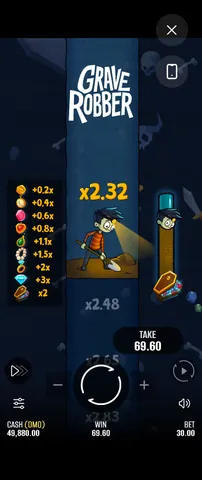
Grave Robber is a browser game built on a canvas renderer, and the Pixmove demo interface reflows across desktop and phone screens rather than dropping anything: the paytable panel, the difficulty selector, the multiplier readout and the crypt progress bar are all present on a phone, just rearranged for the narrower viewport.
There is no download and no installation. Worth stating plainly, because it is a common search: there is no official Grave Robber APK, and we have found no evidence that one exists. Any site offering an installable Grave Robber package should be treated as untrusted. If you want quick access from a phone, the honest answer is a home-screen bookmark, not an app store. The mobile play guide covers orientation, data use and what changes on a small screen.
The name is crowded. There is a Grave Robber on Steam, several unrelated indie games on itch.io, a board game, and a cult film with a similar title. This site covers exactly one of them: the instant-win game published by Pixmove on July 10, 2026, playable in a browser, with a 95% RTP and a x5,000 cap.
If the game you are looking at has a difficulty selector, a shovel-wielding character with a headlamp, and a TAKE button that pays out a running multiplier, you are in the right place. If it has reels, paylines or free spins, it is not this game — and neither is anything involving a pickaxe or equipment durability, a mechanic that appears in some scraped listings but not in Grave Robber. Our frequently asked questions deal with the mix-ups directly, including the persistent claim that an official APK exists.
No numeric rating is shown because the useful comparison is mechanics, RTP and risk shape, not a made-up score.
Grave Robber does the instant-win format well. The dig-and-cash-out loop is genuinely tense, the difficulty selector is a real mechanic rather than a label, and the presentation is polished without getting in the way. Where it is honest, we will be too: the published 95% RTP sits below the best slots, and the headline x5,000 win is realistically a HARD-mode outcome that most sessions never approach. Learn it in the free demo, decide your cash-out multiplier before you start, and it is an enjoyable, fast, low-commitment game.
Made up your mind? Try Grave Robber free in the browser, or read our cash-out strategy first.
Play Grave RobberIf Grave Robber's dig-and-cash-out loop appeals, three other instant-win titles from the same studio, Pixmove, work in a similar risk-and-reward way. They are separate games with their own mechanics — useful context, not substitutes.
The mining theme taken literally: a pickaxe drops and smashes through blocks on the way down, each layer paying out. The game those stray “pickaxe” search results were actually describing — and the closest sibling to Grave Robber.
See it on Pixmove →Another treasure-hunt instant game — digging through a junkyard for hidden value rather than a graveyard. The same one-more-go pull, a different setting.
See it on Pixmove →A crash-style take on the same tension: a roadside launch that climbs for bigger rewards until you cash out or it ends. Faster and more volatile than Grave Robber's EASY mode.
See it on Pixmove →The full round sequence from bet to cash-out, with the official rules and what each control does.
All three paytables side by side, the 95% RTP in context, and how the x5,000 cap is actually reached.
Break-even survival probabilities per difficulty, and why a fixed cash-out target beats playing by feel.
How to reach the no-money demo, and what it does and does not tell you about the real game.
No. Grave Robber is an instant-win game, not a slot. There are no reels, paylines or free spins. You place one bet, then dig repeatedly to build a multiplier and cash out with TAKE whenever you choose. A skull ends the round unless a dice roll saves it, which makes it closer to a crash or cash-out game than a traditional slot.
Grave Robber was developed by Pixmove and the current Pixmove API lists its release date as July 10, 2026. It is a browser-based instant-win game. This site is an independent review and is not operated by Pixmove.
The accumulated multiplier only becomes money when you press TAKE. If you hit a skull and the dice roll does not save you, the whole accumulated amount is lost, however large it had grown. The stake is charged once at the start of the round, not on every dig.
More questions are answered on the Grave Robber FAQ.
Grave Robber runs in the browser on desktop and mobile. Try the demo first — the difficulty setting changes the game more than most players expect.
Grave Robber by Pixmove95% RTP · x5,000 max win · instant browser play
Play Grave Robber