Easy — steady small wins
Opens at x1.04 and creeps up 7% a dig. Symbol values run from +0.2x to +3x. Long rounds, frequent modest cash-outs, small swings. This is the profile the vendor's "Low volatility" label describes.
Grave Robber is Pixmove's instant win game, and every round comes down to one question: dig again, or press TAKE? There is an exact arithmetic answer to that question, and it is different on EASY, MEDIUM and HARD. What follows is that arithmetic, plus an honest account of what it can and cannot do for you at 95% RTP.
In Grave Robber your bet leaves your balance once, at the start of the round. After that you hold a live multiplier that pays only if you cash out. Each successful dig multiplies that figure by a fixed factor. Measured across roughly 45 rounds in the demo, that factor is stable per difficulty: about +7% per dig on EASY, +13% on MEDIUM and +37% on HARD.
Call the growth rate g. Digging again turns a certain win of M into either M × (1 + g) or nothing. The gamble is worth taking only when the chance of surviving the dig, p, satisfies:
p > 1 / (1 + g) — continue only if the survival chance beats the reciprocal of the growth factor. Below that threshold, pressing TAKE has the higher expected value than digging.
| Difficulty | Growth per dig | Break-even survival | Implied skull tolerance |
|---|---|---|---|
| Easy | ≈ +7% | ≈ 93.5% | ≈ 1 in 15 |
| Medium | ≈ +13% | ≈ 88.5% | ≈ 1 in 9 |
| Hard | ≈ +37% | ≈ 73% | ≈ 1 in 4 |
Read that intuitively. On EASY the reward for one more dig is tiny — seven percent — so the dig only pays for itself if skulls are very rare indeed, rarer than one in fifteen. On HARD the reward is enormous, so you can afford to be wrong roughly one dig in four and still come out level. The higher the difficulty, the more risk the ladder is actually paying you to take.
Two caveats, stated plainly. First, Pixmove does not publish the skull probability for any difficulty, so nobody outside the studio can say whether the real p sits above or below these thresholds. Second, and more important, the game returns 95% overall. Whatever the true probabilities are, they are set so that the house keeps its edge. The break-even rule tells you where the trade becomes less bad, not where it becomes profitable.
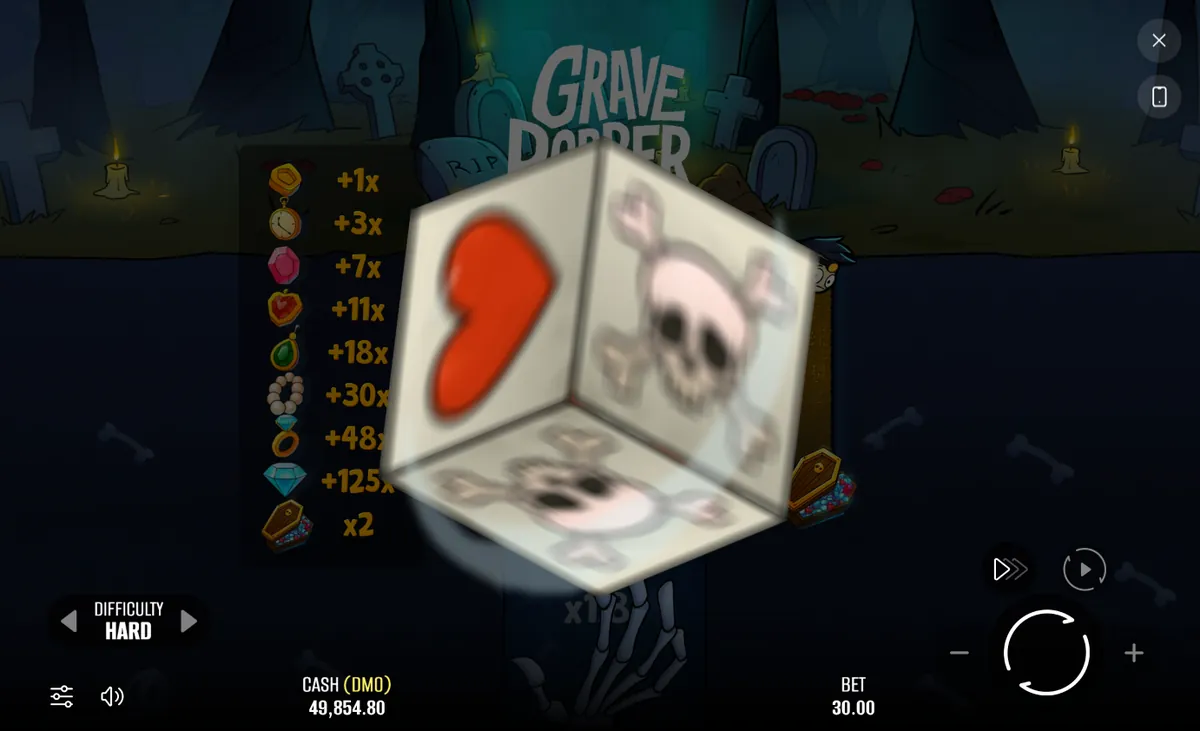
The difficulty selector is chosen before the round starts and cannot be changed mid-round. It swaps the whole paytable and the growth rate at once, which makes it the single biggest decision you make. Pick it to match what you actually want from the session.
Opens at x1.04 and creeps up 7% a dig. Symbol values run from +0.2x to +3x. Long rounds, frequent modest cash-outs, small swings. This is the profile the vendor's "Low volatility" label describes.
Opens at x1.13, climbs about 13%. Symbols run +1x to +20x. A double-your-stake exit arrives within a handful of digs rather than a dozen, at a visibly higher failure rate.
Opens at x1.32 and grows roughly 37% per dig, with a +125x diamond. Rounds end fast. This is the only difficulty where the x5,000 ceiling is arithmetically in reach.
A useful way to frame it: if your goal is to spend a long time in the graveyard for a small stake, EASY does that. If your goal is a large multiplier, EASY cannot deliver it at any length of round, so playing EASY and hoping is simply the wrong tool. The full symbol-by-symbol comparison sits on the RTP and paytable page.
Curious how differently the three settings feel? Grave Robber runs free in the browser — no download, no account — so you can watch EASY and HARD side by side before you stake anything.
Play Grave RobberThe hardest part of Grave Robber is not the maths, it is that the maths has to be applied while a number is climbing in front of you. Deciding "one more" in the moment is how a x5.16 becomes a zero. The fix is mechanical: write down the multiplier you will take at, before you press spin.
A worked example from the demo. A 30.00 stake on EASY reached x5.16 after 19 successful digs and paid 154.80 on TAKE. Nineteen digs is a long survival run on any difficulty. Had that round been played by feel, the natural instinct at x5.16 is to look at the greyed x5.52 on the next rung and reach for the shovel — for an extra 10.80 on a 154.80 stake-equivalent that is already in hand.
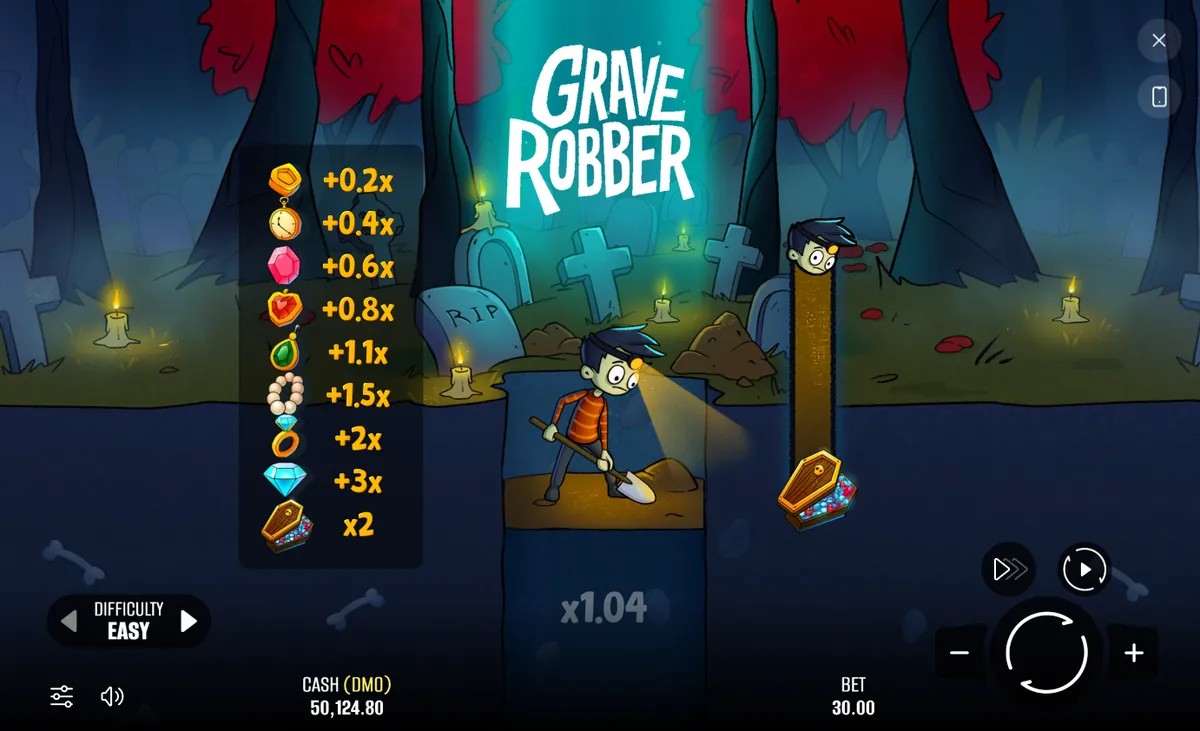
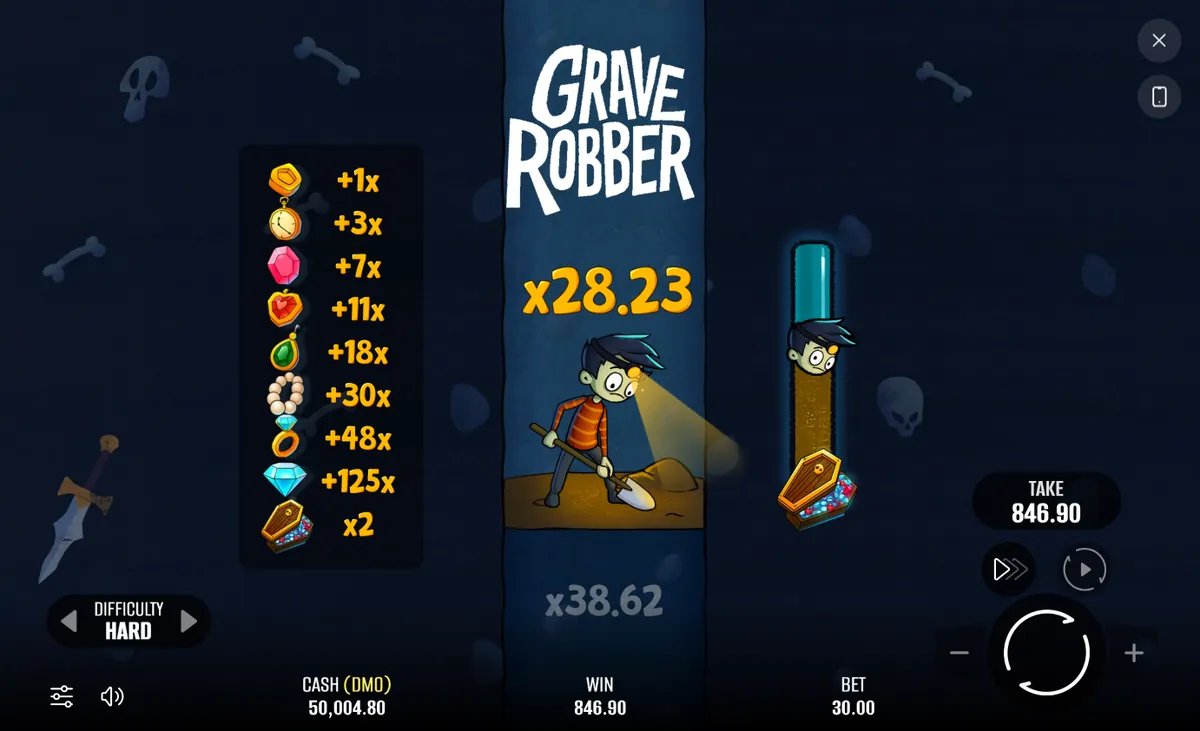
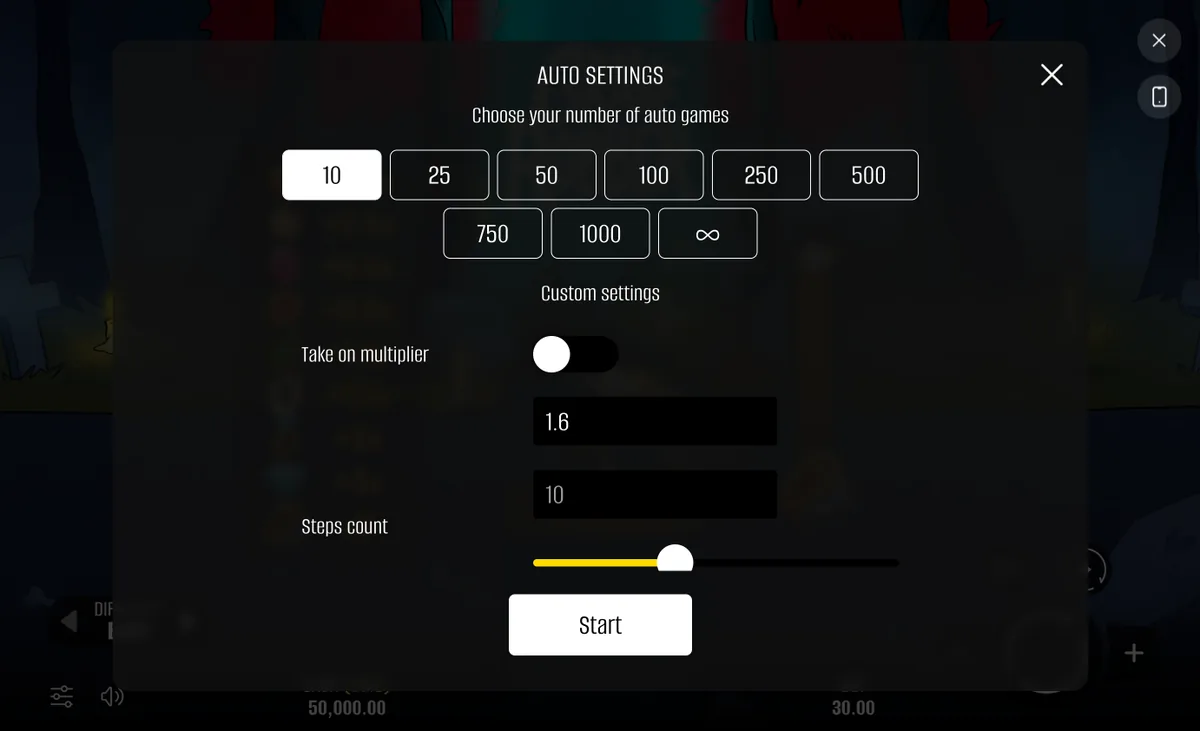
The practical enforcement tool is already in the game. Autoplay's take-on-multiplier setting cashes out automatically the instant the accumulated multiplier reaches a value you set in advance, across a run of 10, 25, 50, 100, 250, 500, 750, 1000 or unlimited rounds. Pair it with the win and loss stop conditions and the entire session is defined before it begins. That is not a way of winning more; it is a way of removing the moment of weakness from the loop.
Turbo mode fast-forwards the animations. It is worth knowing that it also removes the pause that gives you time to think, so it suits pre-set autoplay runs far better than manual play.
The advertised maximum win is x5,000. On HARD, at roughly 37% growth from an x1.32 opening, you need about 26 consecutive successful digs to get there. On EASY the same calculation gives around 125 digs, which the round structure never permits — the descent reaches the crypt long before that.
Twenty-six digs in a row on the difficulty with the highest skull rate is, to be blunt, not something to plan a session around. The honest reading of the cap is that it exists, that it is reachable only on HARD, and that its contribution to the 95% return is spread across an enormous number of rounds that end nowhere near it. Treat it as the shape of the game's tail, not as a target.
After a completed round the game offers ONE LAST GAMBLE: a 50/50 to double the final win or lose it entirely. On a fair coin the expected value of that gamble is exactly the win you already hold. It does not add value and it does not subtract it — it doubles the spread of outcomes and nothing else.
So the decision is not mathematical, it is about what you want the session to feel like. If a single doubled result is the only outcome that would satisfy you, take it. If you are trying to grind a demo bankroll upward with as few zeroes as possible, decline it every time. Both answers are defensible; "it's due" is not a reason, because each gamble is independent of every one before it.
Grave Robber returns 95% of stakes over the long run. That 5% is charged on every bet placed, regardless of how those bets are sized or sequenced. It follows that:
Be clear about this: no cash-out point, difficulty choice or autoplay configuration on this page makes Grave Robber a positive-expectation game. Everything above is bankroll and variance management — deciding in advance how much you are willing to lose, and how wild a ride you want on the way.
If any of that starts feeling less like a decision and more like a compulsion, stop and read our responsible gaming page. New to the game entirely? Start with how to play, or the mechanic-by-mechanic breakdown on the game features page. Everything else lives on the Grave Robber home page.
If you only want the short version of any of this, the FAQ condenses each point into a direct answer.
No strategy makes Grave Robber profitable. At 95% RTP the house edge is permanent, and no cash-out point, difficulty choice or betting system changes the expected value. Strategy here means managing variance and bankroll: choosing a difficulty that fits your goal and deciding your cash-out multiplier in advance.
It depends on the session you want, not on the odds, since all three share the same RTP. EASY gives long rounds and frequent small cash-outs. HARD gives short, volatile rounds and the only realistic route to the biggest wins. MEDIUM sits between them.
Decide your cash-out multiplier before the round starts rather than in the moment, and use autoplay's take-on-multiplier setting to enforce it. That removes the hesitation where most accumulated multipliers are lost. There is no mathematically correct point, so pick a target you are comfortable with and keep to it.
More questions are answered on the Grave Robber FAQ.
Pick the difficulty, pick the cash-out multiplier, then start the round. That order is the whole strategy.
Grave Robber by Pixmove95% RTP · x5,000 max win · instant browser play
Play Grave Robber