All three difficulties
EASY, MEDIUM and HARD are all selectable, each with its own paytable and its own ladder growth rate. Nothing is locked behind a real-money balance.
The Grave Robber instant win game by Pixmove has a playable free demo on the developer's own game page. It runs on a play-money balance, all three difficulties are selectable, and every mechanic in the paid game is present. Here is how to reach it, and what a demo session honestly tells you.
Pixmove publishes a playable demo of Grave Robber on its own game page. Open pixmove.com/games/grave_robber and press the PLAY DEMO button. That is the vendor's page for its own product, not an affiliate link and not a mirror — it is simply where the developer hosts the demo build.
The demo loads in the browser. There is no download, no account, no email address and no deposit. It opens with a play-money balance already credited, and stakes are set with the same bet control the real game uses. Because the balance is fictional, nothing you win in the demo can be withdrawn, and nothing you lose costs anything.
The free version is not a cut-down teaser. Recorded across roughly 45 rounds in the demo, all of the following behaved exactly as the paid game's rules describe:
EASY, MEDIUM and HARD are all selectable, each with its own paytable and its own ladder growth rate. Nothing is locked behind a real-money balance.
Skulls appear as normal, and the six-sided die with its single heart face is rolled as the second chance. A save at x1.32 on HARD was recorded and the round continued.
Reaching the crypt opens the jewel-filled coffin for a flat x2, and the ONE LAST GAMBLE 50/50 double-or-nothing is offered on the final win.
The full autoplay range — 10, 25, 50, 100, 250, 500, 750, 1000 and unlimited — with take-on-multiplier and win/loss stop rules.
Turbo mode fast-forwards the dig animations, which matters more than it sounds when you want to see a hundred rounds rather than ten.
The in-game paytable panel is readable per difficulty, so you can confirm every symbol value yourself rather than taking ours on trust.
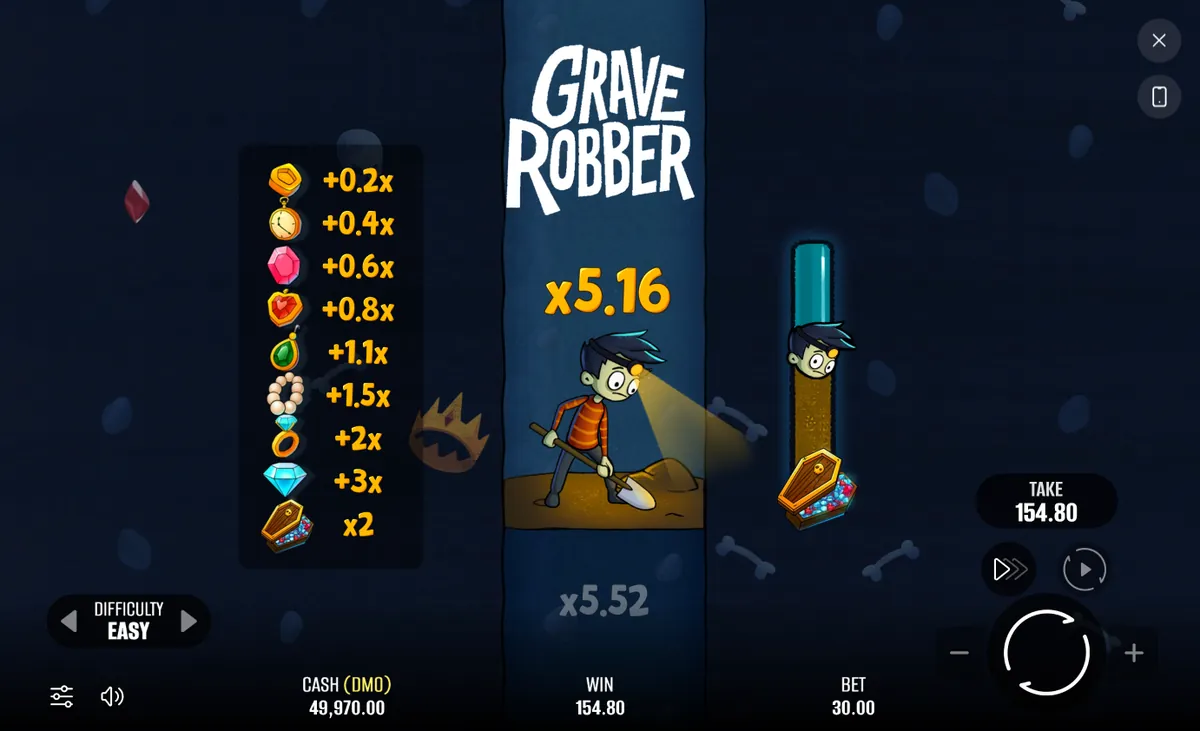
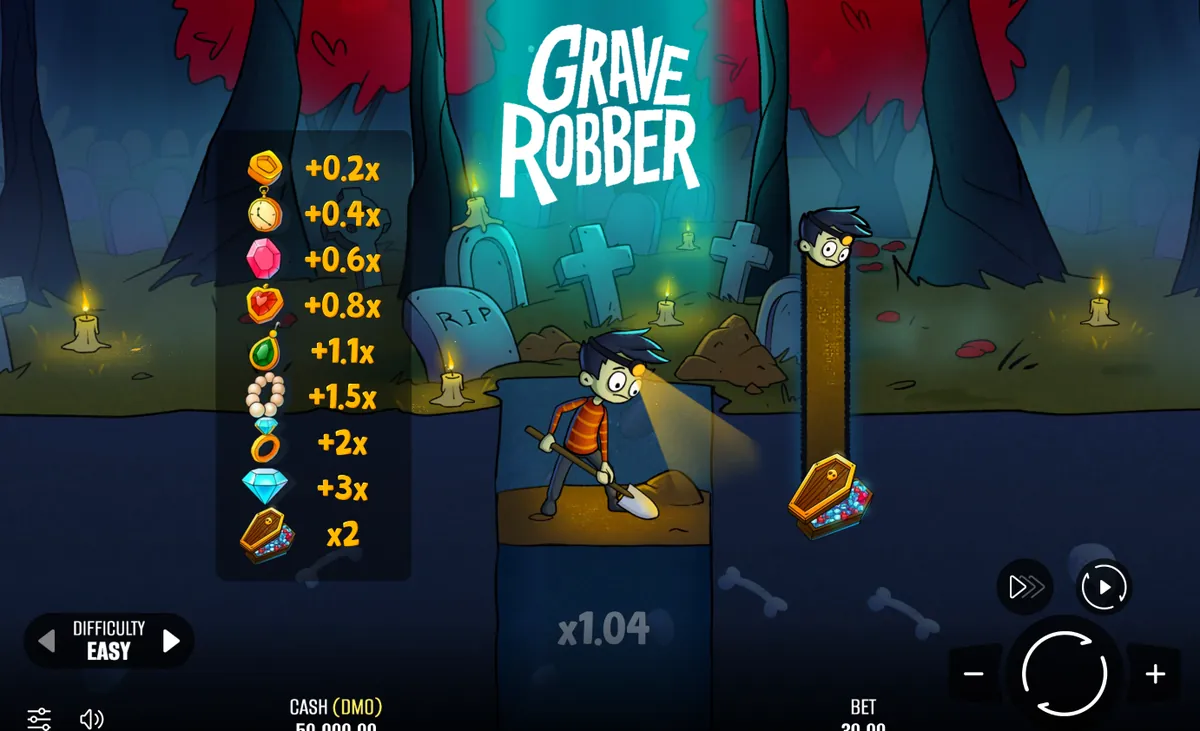
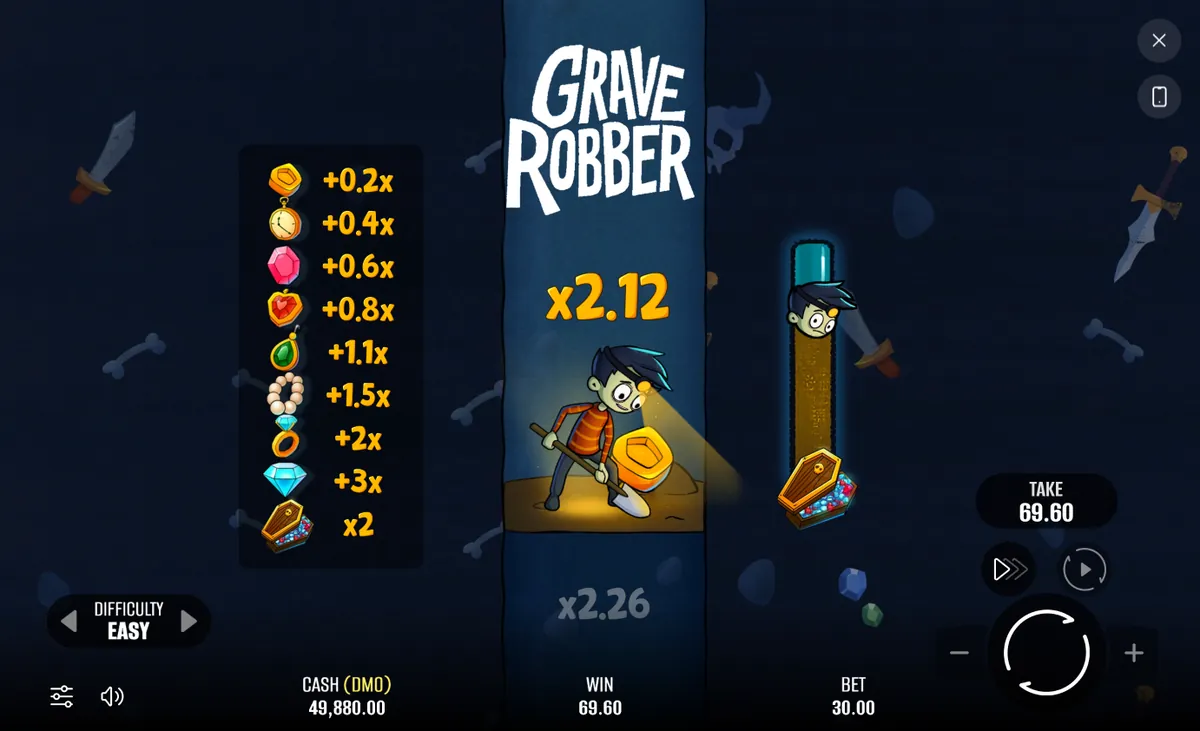
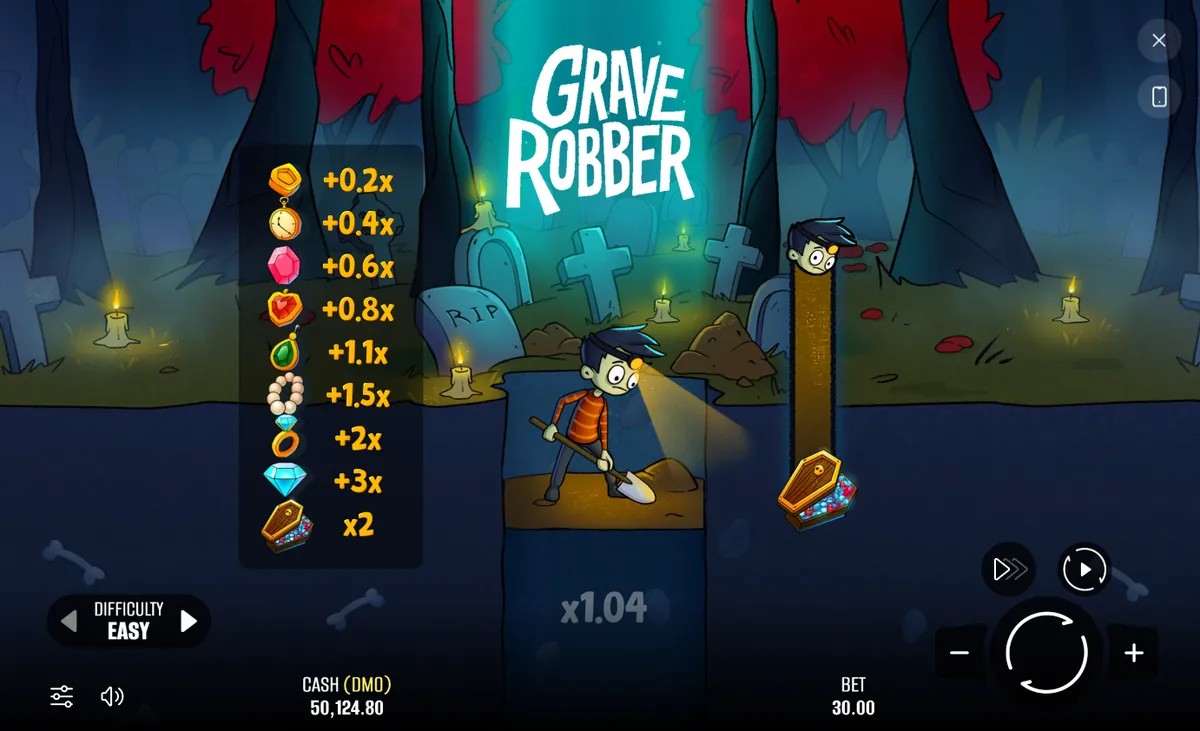
This is the single best reason to open the demo. On paper EASY, MEDIUM and HARD look like a risk slider. In practice they are three different games. EASY opens at x1.04 and gains roughly 7% per dig; MEDIUM opens at x1.13 and gains about 13%; HARD opens at x1.32 and gains about 37%. The top symbol is worth +3x on EASY and +125x on HARD.
Reading those numbers is one thing. Playing twenty rounds on EASY and then twenty on HARD is another — the pacing, the number of digs you get before a skull, and how a round feels are entirely different. Do that before you decide which difficulty you actually want to play for money. The full symbol-by-symbol comparison is on the RTP and paytable page.
Grave Robber gives you exactly one meaningful decision per round: when to press TAKE. The demo is the right place to practise making that decision by a rule instead of by feel.
Pick a target before the round starts — say x3 on EASY — and take at that number every single time for fifty rounds, without exception, including the rounds where the ladder is still climbing and it feels wrong to stop. Then try a different target. You will find out quickly whether you can actually hold a rule when the multiplier is above it, which is a far more useful thing to know about yourself than any number on a paytable. Break-even survival probabilities per difficulty are worked through on the strategy page.
Seeing the dice roll for yourself, watching the coffin double a multiplier, and finding out what ONE LAST GAMBLE does to a win you were happy with are all cheaper lessons in the demo. The game features page covers each mechanic in detail, but reading about the gamble and losing a x40 to it are not the same experience.
Ready to open it yourself? The Grave Robber demo runs free in the browser — no download, no account — and carries every mechanic the paid game has.
Play Grave RobberA short demo session says nothing reliable about the 95% RTP. Pixmove publishes a return to player of 95%. That figure is a long-run average across an enormous number of rounds — hundreds of thousands, not dozens. Forty rounds, or four hundred, sit comfortably inside the range of normal variance in either direction.
This matters because of how people actually use demos. A run of good luck in a play-money session gets read as "this game pays"; a run of early skulls gets read as "this game is tight". Neither reading is supported by the sample size. If your demo session returned well above your total stakes, that is variance. If it returned almost nothing, that is also variance. The only number you can rely on is the published one, and 95% means that across the very long run the game keeps roughly 5 units in every 100 staked.
Two more limits worth being clear about:
The single most valuable thing the demo can produce is not a win. It is an honest answer to the question of whether you can press TAKE at your own number when the game is telling you to keep digging.
| Element | Free demo | Real money |
|---|---|---|
| Difficulties available | All three | All three |
| Paytable values | Identical | Identical |
| Skull, dice, coffin, gamble | All present | All present |
| Autoplay and turbo | Present | Present |
| Balance | Play money, cannot be withdrawn | Your own funds |
| Account required | No | Yes |
| Decision pressure | None — and that is the catch | Real |
One honest caveat: the demo is hosted by the developer, and demo builds are not always guaranteed to be mathematically identical to the certified real-money build. We have no evidence of a difference in Grave Robber — the rules, paytables and mechanics matched the published rules in every round we recorded — but the sample cannot prove equivalence either. Treat the demo as a faithful guide to the rules, not as a measurement of the return.
If you have used the demo properly, you should be able to answer three questions before you stake anything: which difficulty you are playing and why, what multiplier you will take at, and what you will do the first time a round runs past that number. If any of those three is still "I'll see how it goes", go back to the demo — it costs nothing to find out there.
Start with the how to play guide if you have not run a round yet, or go back to the Grave Robber overview for the headline numbers.
Questions the demo tends to raise — whether it matches the real game, and why there is no downloadable version — are answered in the Grave Robber FAQ.
Yes. Pixmove publishes a free demo of Grave Robber on its own game page, playable with a play-money balance. All three difficulties and every mechanic are available, and no deposit or account is required to try it.
No. The Grave Robber demo runs straight in the browser with no sign-up, no deposit and no personal details. It uses a virtual balance, so nothing you win or lose in the demo is real money.
Not reliably. A short demo session is far too small a sample to reveal the 95% RTP, which only emerges over a very large number of rounds. The demo is useful for learning the difficulty differences and rehearsing a cash-out plan, not for judging payout rates.
More questions are answered on the Grave Robber FAQ.
The demo carries the full game — all three difficulties, the dice, the coffin and the gamble. Use it to pick a difficulty and set a cash-out rule before any money is involved.
Grave Robber by Pixmove95% RTP · x5,000 max win · instant browser play
Play Grave Robber