Round counts
10, 25, 50, 100, 250, 500, 750, 1000 or ∞ (unlimited).
Grave Robber by Pixmove is an instant win game, not a slot, so its feature list looks nothing like a reel game's. There are no paylines, no free spins and no bonus buy. What it has instead is a difficulty selector, a running multiplier, a skull that ends the round, a die that can rescue it, and a coffin at the bottom. Here is each one, in the order you meet it.
Chosen before the round begins and locked for its duration, the EASY / MEDIUM / HARD selector is the most consequential control in the game. It does two things at once: it swaps the entire treasure paytable, and it changes the rate at which the accumulated multiplier climbs, which in turn changes how often a skull turns up.
| Difficulty | Opening | Growth per dig | Top symbol |
|---|---|---|---|
| Easy | x1.04 | ≈ +7% | +3x |
| Medium | x1.13 | ≈ +13% | +20x |
| Hard | x1.32 | ≈ +37% | +125x |
Pixmove labels the game "Low" volatility on its own product page. That description fits EASY well and HARD not at all — on HARD the ladder passes x13 within about eight digs and ends abruptly far more often. What the choice means for expected value is worked through on the Grave Robber strategy page.
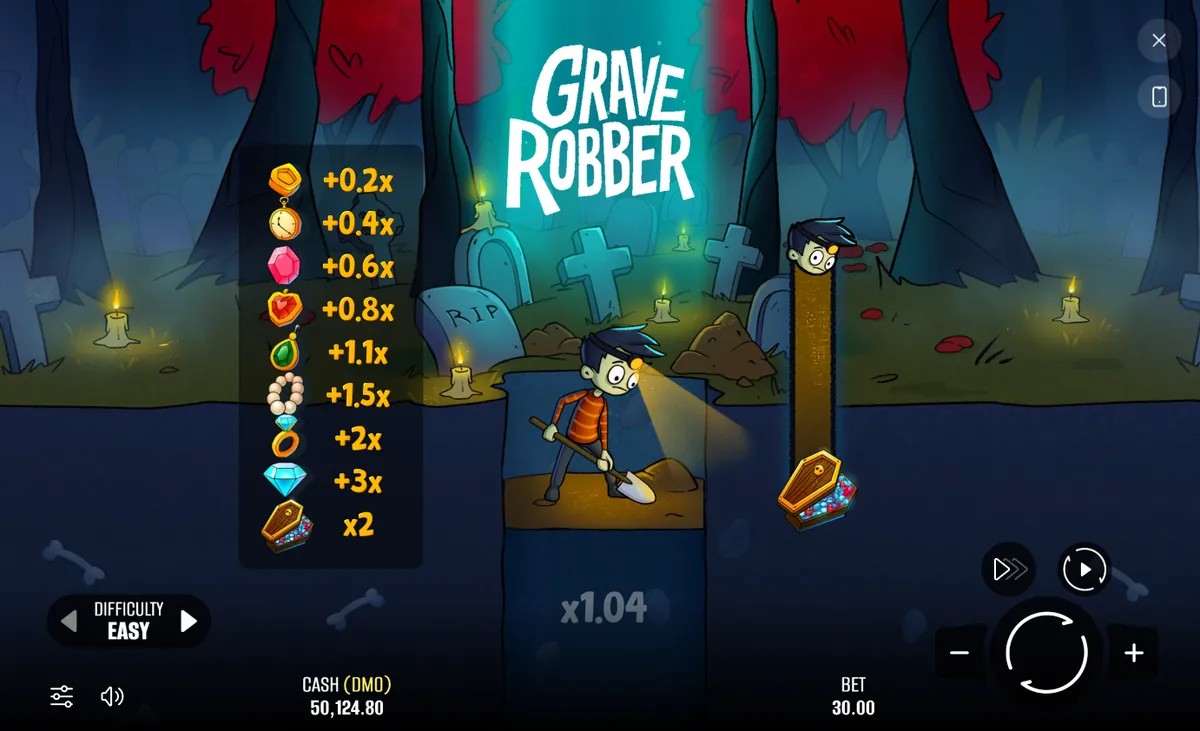
Each dig either uncovers a piece of treasure or a skull. Treasure values are added to the accumulated multiplier rather than multiplied into it, and there are eight of them: gold ring, pocket watch, pink gem, ruby heart pendant, emerald pendant, pearl necklace, sapphire ring and diamond.
The eight treasure symbols are identical across all three settings; only their values change. On EASY the gold ring adds +0.2x and the diamond +3x; on HARD those become +1x and +125x. The coffin is the one constant, doubling the accumulated multiplier x2 on every difficulty. The complete symbol-by-symbol breakdown for all three settings, with an interactive difficulty switch, lives on the RTP and paytable page — it is the canonical reference for those numbers and is kept in one place deliberately.
Note how the spread widens with difficulty. On EASY the best symbol is fifteen times the worst; on HARD it is a hundred and twenty-five times. The full paytable screenshots for all three modes are on the RTP and paytable page.
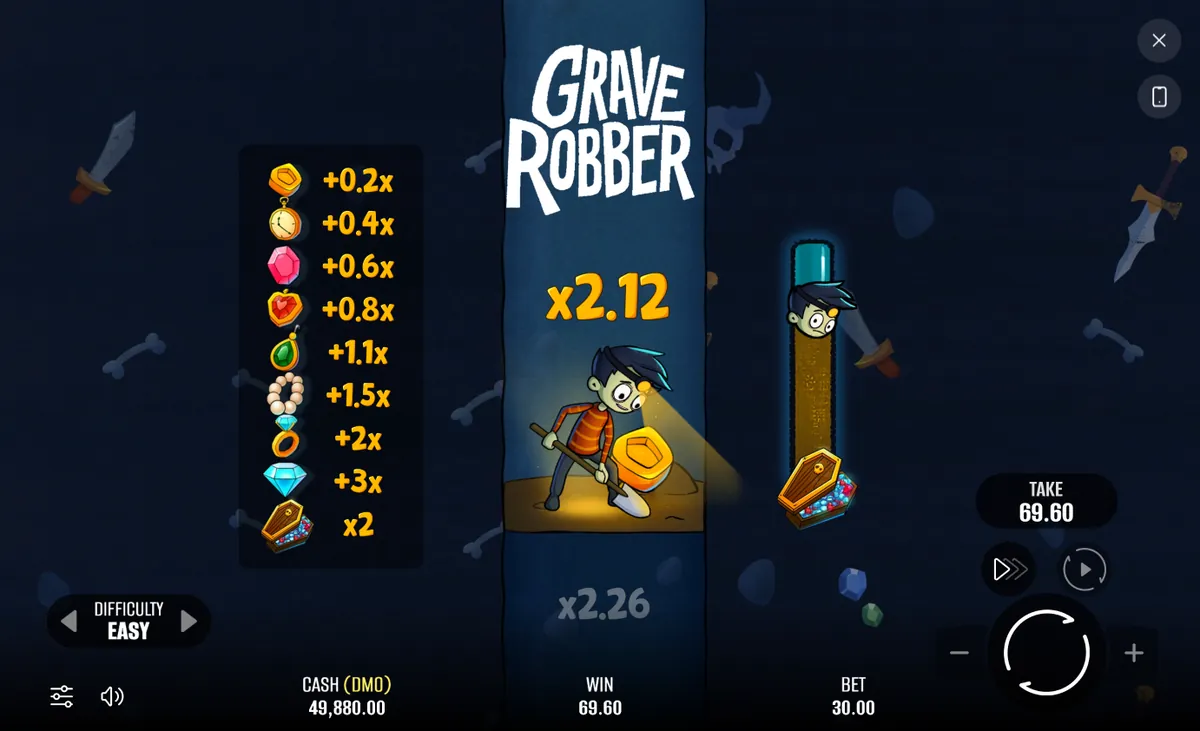
Your stake leaves the balance once, at the start of the round, and is not charged again per dig. From that moment the TAKE button is live and stays live until the round ends. Pressing it pays the accumulated multiplier times your bet, immediately.
Recorded in the demo: a 30.00 stake on EASY reached x5.16 after 19 successful digs and paid 154.80 on TAKE. The multiplier only ever becomes money at the moment you press that button.
Instead of treasure, the shovel turns up a snake-wrapped skull. By the official rules the round is lost at that point — the accumulated multiplier is wiped, however large it had grown, and the bet is gone. There is no partial payout and no consolation.
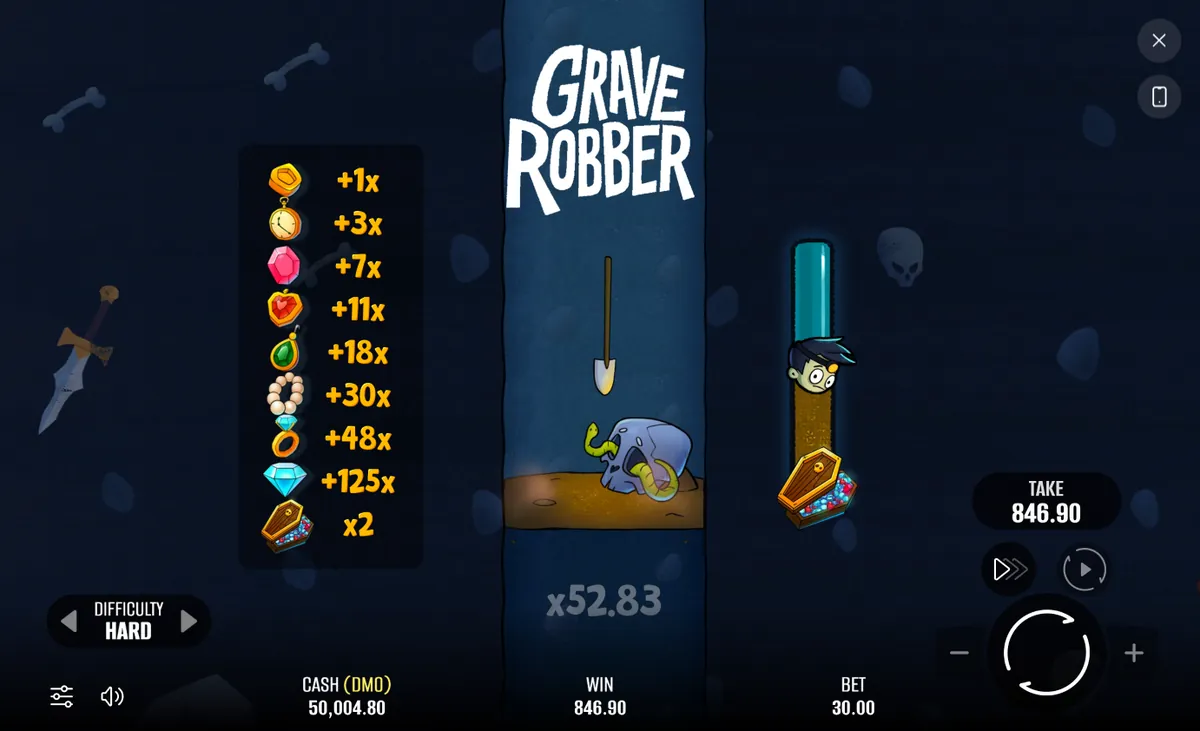
The skull is not a "feature" you can play around, and its frequency is not published for any difficulty. What can be said from play is that skulls arrive noticeably sooner on HARD than on EASY, which is consistent with the ladder growing so much faster there.
The skull is not always the end. A skeleton hand rolls a giant six-sided die. Its faces show skulls plus a single red heart. Land the heart and the character survives: the round continues and the multiplier accumulated so far is preserved in full. Roll any other face and the round ends.
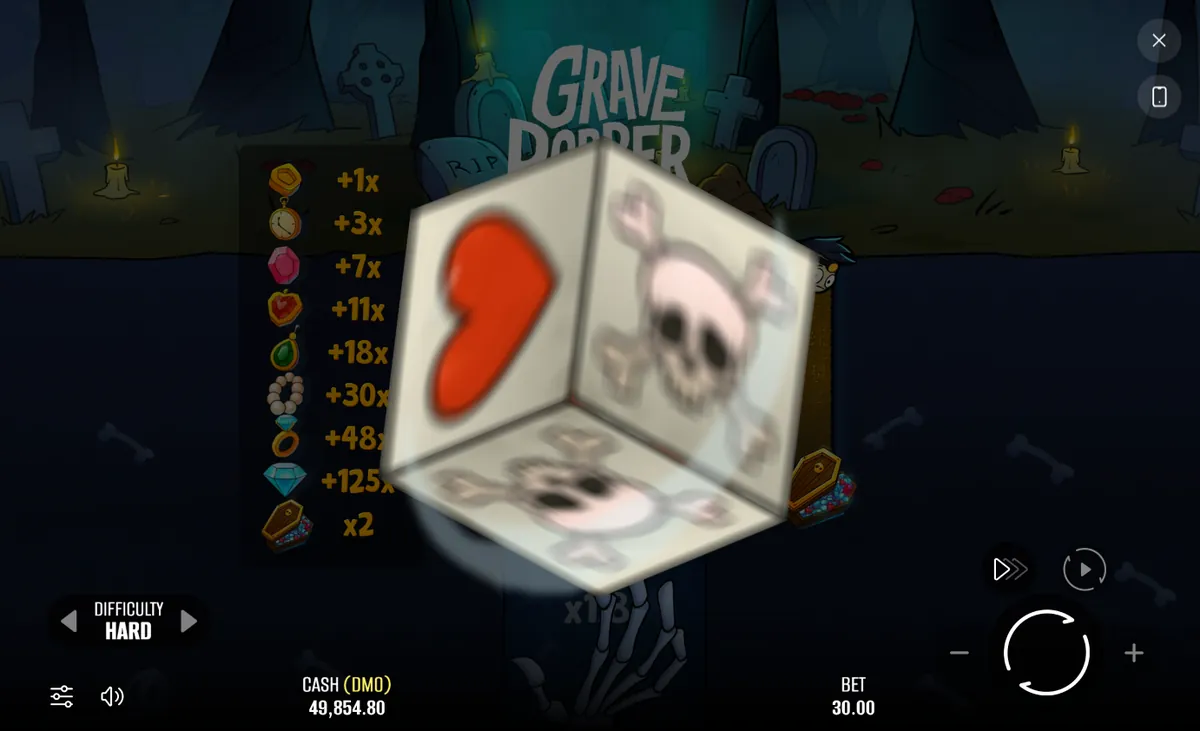
On the odds: the die has six faces and one of them is a heart, so the save looks like roughly 1 in 6. Pixmove does not publish the actual probability, and nothing in the rules text confirms that every face is equally weighted. Treat 1-in-6 as inferred from what is visible on the die, not as a stated figure.
A vertical bar runs down the right-hand side of the play area, tracking how far the character has descended toward the crypt. It is the only indication of how much round is left, and it is why a Grave Robber round is finite rather than open-ended: survive far enough and the descent completes on its own.
This is also the reason the x5,000 cap is unreachable on EASY. At about 7% growth per dig you would need roughly 125 successful digs, and the crypt arrives long before that. On HARD the same ceiling needs around 26 digs, which the round structure does allow.
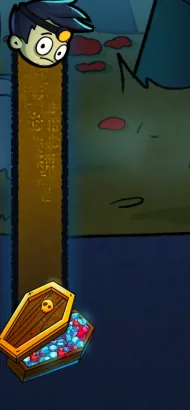
Every feature here is live in the free demo. Pick a difficulty, dig, and watch the crypt bar fill — no download, no account.
Play Grave RobberReaching the crypt opens a jewel-filled coffin, and it doubles the accumulated multiplier — a flat x2, identical on EASY, MEDIUM and HARD. It is the game's only fixed, guaranteed-value event, and it is the reward for surviving the whole descent rather than cashing out early.
Worth being precise about what this is: it is not a "bonus round" with its own gameplay, and it is not something you can trigger or buy. It happens automatically at the end of a completed round.
After the win is settled the game offers ONE LAST GAMBLE, described in its own UI as 50/50 — double your win or lose it all. Take it and the final win either doubles or goes to zero. Decline it and the win is banked.
At a straight 50/50 the expected value of the gamble equals the win you already hold, so it adds no edge in either direction. It only widens the range of outcomes. There is more on that trade-off, and on why "it's due" is never a reason, on the strategy page.
Autoplay runs rounds unattended and is the most genuinely useful tool in the interface, because it can enforce a cash-out decision you made while calm.
10, 25, 50, 100, 250, 500, 750, 1000 or ∞ (unlimited).
Set a target multiplier and each round cashes out automatically the moment it is reached. This is the in-game way to commit to an exit point in advance.
Halt the run once total winnings pass a threshold you define.
Halt the run once losses reach a limit you define — the single most useful setting on the panel.
Turbo fast-forwards the dig, skull and dice animations. It changes nothing about outcomes, payouts or probabilities — only how long each round takes to watch. The practical side effect is that it also removes the natural pause before each decision, so it pairs far better with a pre-set autoplay run than with manual play.
Worth stating plainly, because listings elsewhere get this wrong. There are no reels, paylines, scatters, wilds, free spins or bonus buy in Grave Robber. There is no pickaxe mechanic and no equipment durability of any kind — search results describing those belong to a different game entirely. It is an instant win cash-out ladder, and the list above is the complete feature set.
You can confirm every one of these yourself for nothing in the free demo, or read the round sequence end-to-end in how to play. The overview lives on the Grave Robber home page.
The dice are the second-chance mechanic. When you uncover a skull, a six-sided die is rolled by a skeleton hand. Its faces show skulls plus a single red heart. Land the heart and the character survives, keeping the accumulated multiplier. It looks like roughly a 1-in-6 chance, though Pixmove does not publish the exact odds.
Reaching the crypt at the end of a round opens a jewel-filled coffin, which doubles the accumulated multiplier by a flat x2 on every difficulty. It happens automatically on a completed round and is the reward for surviving the full descent rather than cashing out early.
No. Grave Robber has no bonus buy, no free spins and no purchasable feature. Its interface borrows a generic engine template that mentions such things, but they are not active in this game. The only optional extra is ONE LAST GAMBLE, a 50/50 double-or-nothing on the final win.
More questions are answered on the Grave Robber FAQ.
The dice save and the coffin x2 are both worth watching once before you decide which difficulty suits you.
Grave Robber by Pixmove95% RTP · x5,000 max win · instant browser play
Play Grave Robber