Grave Robber is an instant win game by Pixmove — not a slot. One bet buys
you a dig through a graveyard, each successful strike adds a treasure value to a running
multiplier, and you decide when to stop. This page walks the whole round in order, from the bet
control to the final 50/50, using the rules text from the game itself and behaviour recorded
across roughly 45 rounds in the demo.
Before the walkthrough, here is the description Pixmove ships inside the client. It is worth
reading once, because it is unusually precise about the two things players get wrong: that the
difficulty is locked before the round, and that winnings are the accumulated multiplier times
the bet.
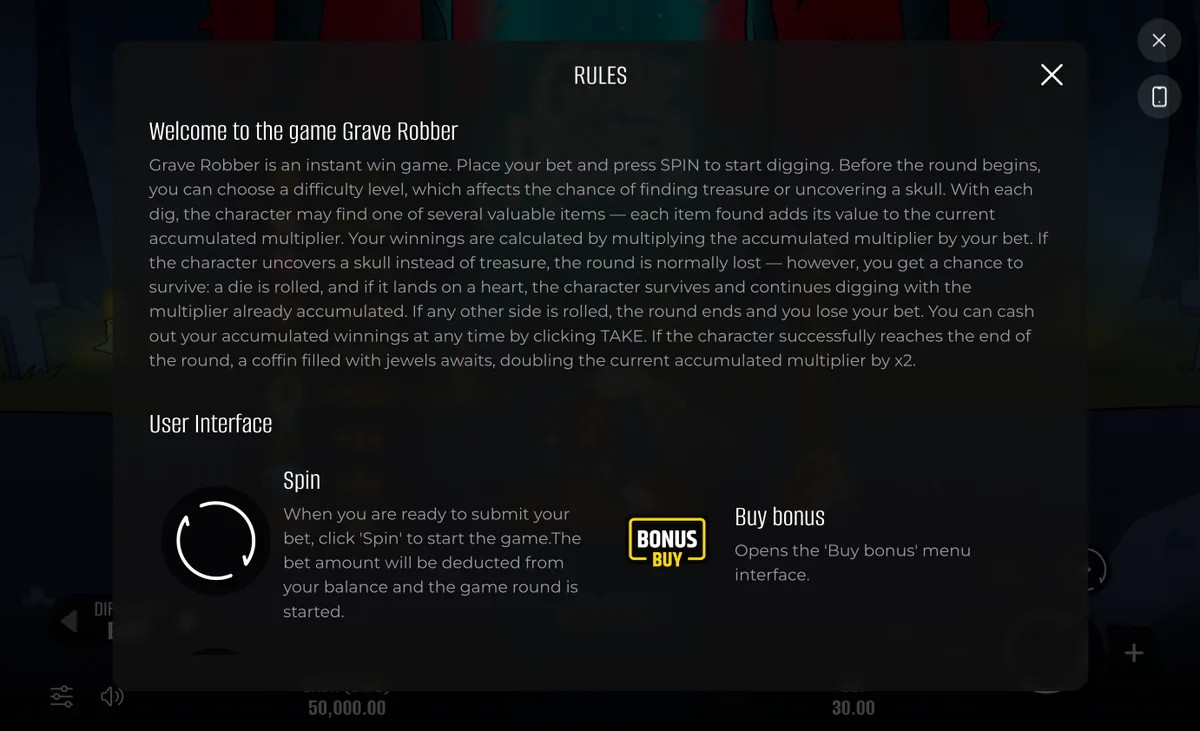
“Grave Robber is an instant win game. Place your bet and press SPIN to start digging.
Before the round begins, you can choose a difficulty level, which affects the chance of finding
treasure or uncovering a skull. With each dig, the character may find one of several valuable
items — each item found adds its value to the current accumulated multiplier. Your
winnings are calculated by multiplying the accumulated multiplier by your bet. If the character
uncovers a skull instead of treasure, the round is normally lost — however, you get a
chance to survive: a die is rolled, and if it lands on a heart, the character survives and
continues digging with the multiplier already accumulated. If any other side is rolled, the
round ends and you lose your bet. You can cash out your accumulated winnings at any time by
clicking TAKE. If the character successfully reaches the end of the round, a coffin filled with
jewels awaits, doubling the current accumulated multiplier by x2.”
— Grave Robber in-game rules screen, Pixmove
The rules exactly as Grave Robber presents them in its own menu, alongside the
interface guide.
The round, step by step
Set your bet. The bet control sits under the dig area and sets the stake for
the whole round. It is the only money that leaves your balance: everything after this is
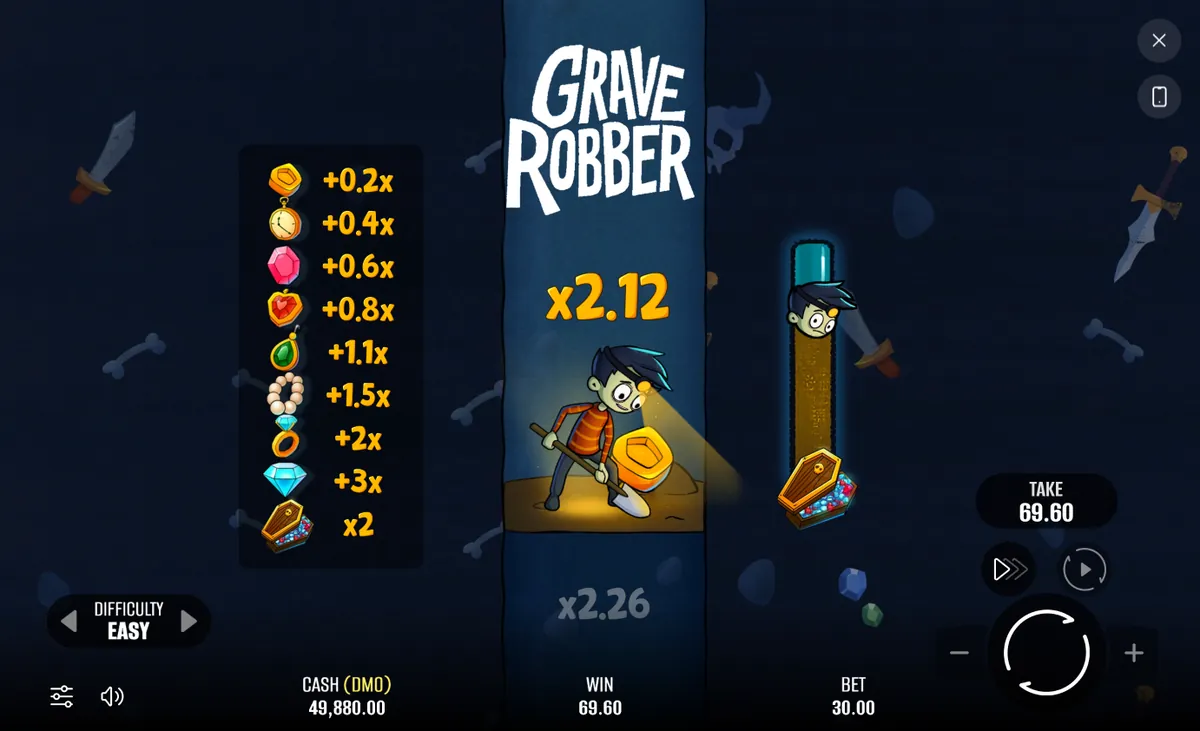
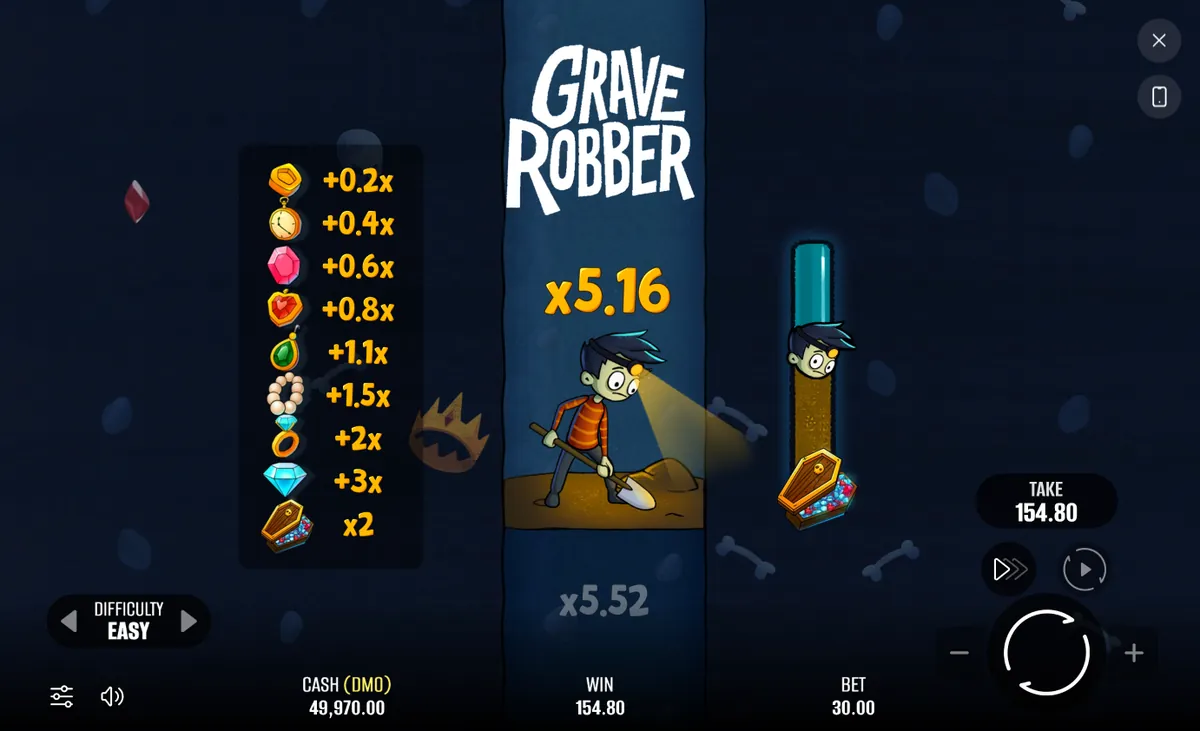
multiplication. On a 30.00 stake, an accumulated multiplier of x5.16 pays 154.80 — that
is a real figure recorded on an EASY round, not an illustration.
Choose EASY, MEDIUM or HARD — before you start. This is the decision
that matters most, and the game will not let you change it once the round is live. Difficulty
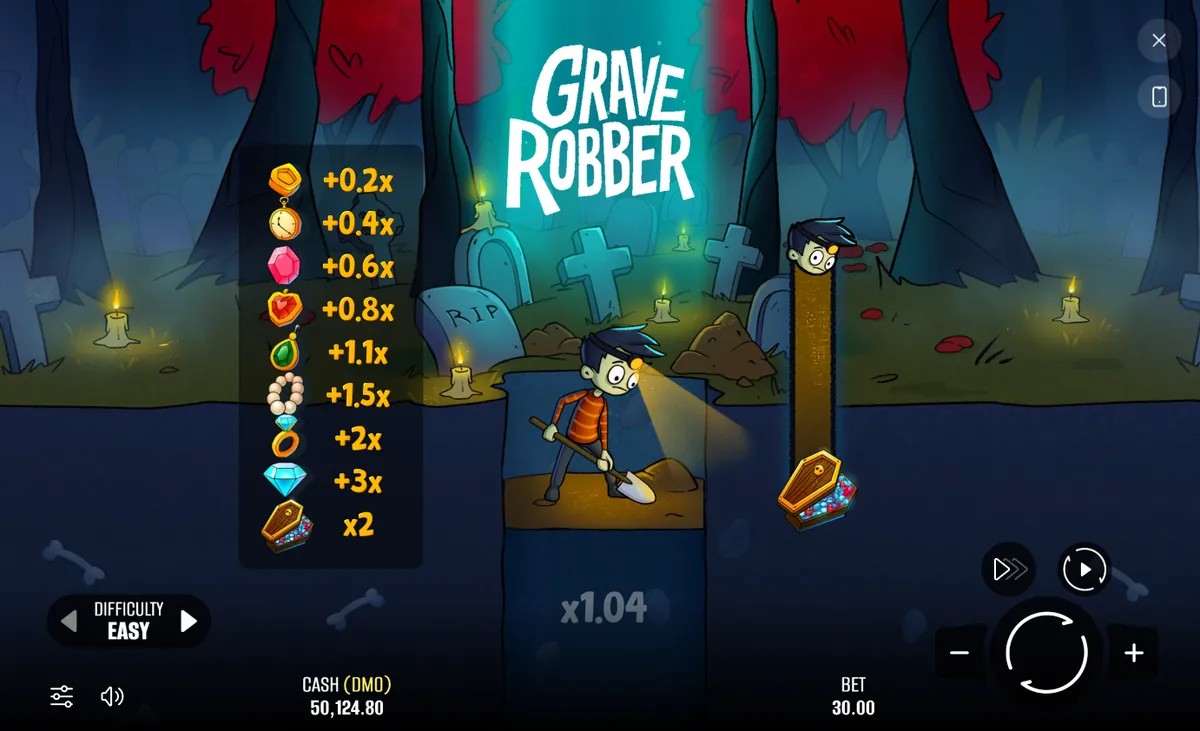
swaps the whole paytable and the ladder growth rate: EASY opens at x1.04 and climbs
roughly 7% per dig, MEDIUM opens at x1.13 for about 13%, HARD opens at x1.32 for about 37%.
Faster growth is bought with a higher skull rate, so these are effectively three different
games sharing one screen. Symbol-by-symbol values are on the
RTP and paytable page.
Press SPIN to dig. The first press deducts the stake and opens the round;
the multiplier appears at the difficulty's opening value. Every press after that is a dig,
and no further money is taken — a point that trips up players coming
from slots, where each spin costs. The screen shows the current multiplier, the value the
next successful dig would take you to (greyed out below it), and the crypt progress bar down
the right-hand side.
Press TAKE whenever you want the money. TAKE is live from the moment the
round opens and pays stake × accumulated multiplier. There is no minimum number of
digs. This is the only way the multiplier ever becomes a balance: an unpressed multiplier,
however large, is worth nothing if the round ends badly.
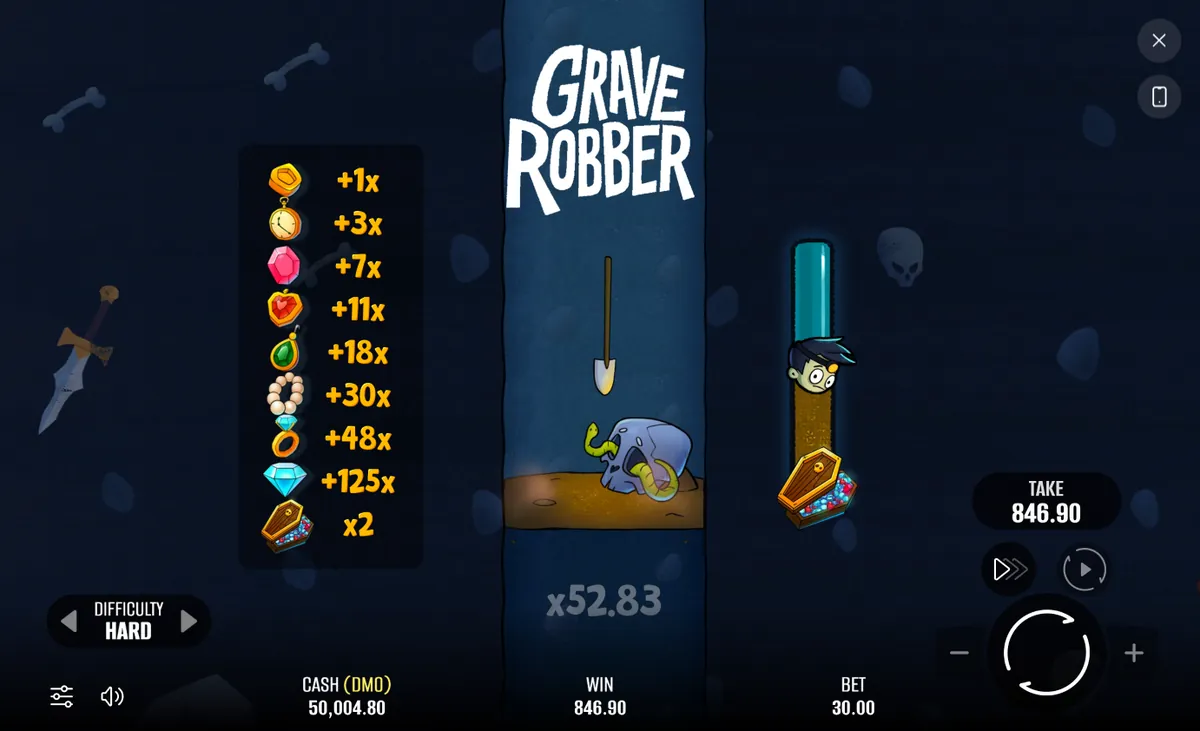
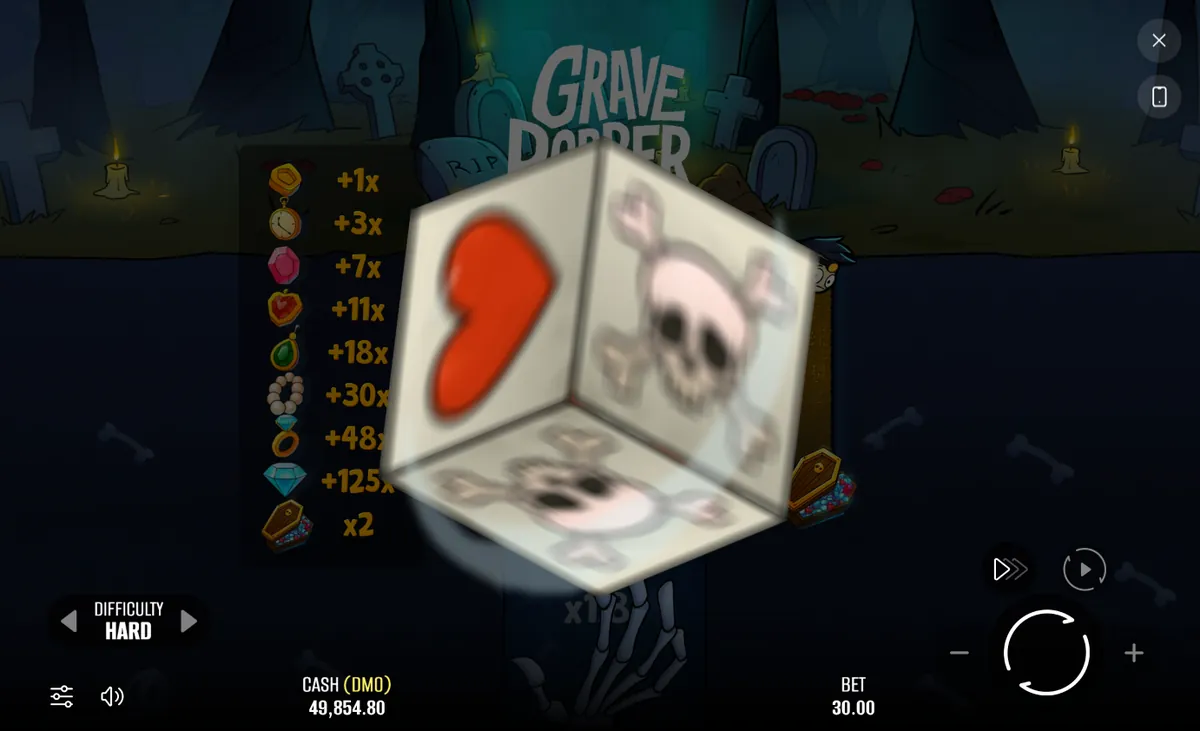
If a skull turns up, watch the die. Instead of treasure the shovel uncovers a
snake-wrapped skull, and by default the round is over. A skeleton hand then rolls a giant
six-sided die whose faces carry skulls and a single red heart. The heart means the character
survives and carries on digging with the multiplier already banked — one face in six,
so roughly a 1-in-6 reprieve. Any other face ends the round and the stake is lost.
Reach the crypt and open the coffin. Survive all the way to the end of the
round and a jewel-filled coffin doubles the accumulated multiplier. It is a flat
x2 on every difficulty — the one number that does not change with the
setting.
Decide on ONE LAST GAMBLE. The game offers a final optional bet, labelled
50/50 — double your win or lose it all, on the win you are holding. Take it
and the amount either doubles or goes to zero; decline and the win is banked as shown under
CURRENT WIN.
The round in pictures
A dig that finds treasure adds the symbol's value to the running multiplier.A skull instead of treasure — the round is lost unless the die saves it.The dice save: five skull faces and one heart, so roughly a 1-in-6 reprieve.Pressing TAKE turns the accumulated multiplier into a real balance.
Rules make more sense once you have dug a few graves. The demo is free, runs
in the browser, and needs no account.
The single rule to internalise: the stake is charged once, at the start.
After that the only two outcomes that end a round are TAKE and an unsaved skull — and
only one of them pays.
The EASY round described above, sitting at x5.16 after 19 digs. The greyed figure
beneath the multiplier is what the next successful dig would pay; the crypt progress bar runs
up the right-hand edge.
What a skull actually costs you
Because the stake is a one-off, the real cost of a skull is not the stake — it is the
multiplier you had already earned and did not take. That is why the dice roll feels far more
important than its 1-in-6 frequency suggests: on a deep HARD run it is the difference between a
three-figure multiplier and nothing.
The skull reveal. The round is lost from here unless the die that follows lands its
single heart face.
The practical reading is simple. Set a multiplier you are happy to take before you press SPIN,
and take it. Playing by feel means the round is decided by the skull rather than by you. The
break-even survival rates that make this arithmetic rather than opinion are worked through on the
strategy page.
The interface controls
Beyond the bet, difficulty, SPIN and TAKE, the panel carries four supporting controls. None of
them changes the odds — they change how quickly and how automatically the rounds go by.
Autoplay
Runs a batch of rounds without input: 10, 25, 50, 100, 250, 500, 750, 1000 or unlimited.
It carries a take-on-multiplier rule — the point at which it presses TAKE for you
— plus stop-on-win and stop-on-loss limits. Setting the take-on-multiplier is the
closest the game gets to enforcing a plan on you, which is exactly why it is useful.
Turbo
Fast-forwards the dig and reveal animations. Rounds resolve in a fraction of the time. It
does not alter the paytable, the growth rate or the skull frequency — only the pace,
and therefore how much you stake per hour.
Sound
A straight mute toggle for the music and effects. Worth knowing that the dice roll has its
own audio cue; with sound off you have to watch for the heart face rather than hear it.
Settings and rules
The settings menu holds the language switch (the game ships in English and Spanish) and
opens the rules and paytable screens — the paytable is difficulty-specific, so check it
after you switch, not before.
Grave Robber is adaptive and runs the same way on desktop, tablet and mobile, so these
controls sit in the same order whichever device you open it on. A full feature-by-feature
breakdown, including the crypt bar and the gamble screen, is on the
game features page, and the
Grave Robber overview has the headline numbers in one
place.
Still unsure about a specific rule? The Grave Robber FAQ answers the questions players ask most often, including what happens to your stake if the connection drops mid-round.
Frequently asked questions
How do you win at Grave Robber?
You win by cashing out with TAKE before hitting a skull. Each successful dig adds a treasure value to your multiplier, and TAKE pays that multiplier times your stake. There is no minimum number of digs, so you can take a small, near-certain win early or risk more digs for a larger one.
Is the bet charged for every dig?
No. Your stake is deducted once, when you press SPIN to start the round. Every dig after that is free, and only the risk to your accumulated multiplier grows. This is the main difference from slots, where each spin costs money.
What happens when you uncover a skull?
A skull normally ends the round and loses the accumulated multiplier. You get one chance to survive: a six-sided die is rolled, and if it lands on its single heart face the character survives and keeps the multiplier. Any other face ends the round and the stake is lost.